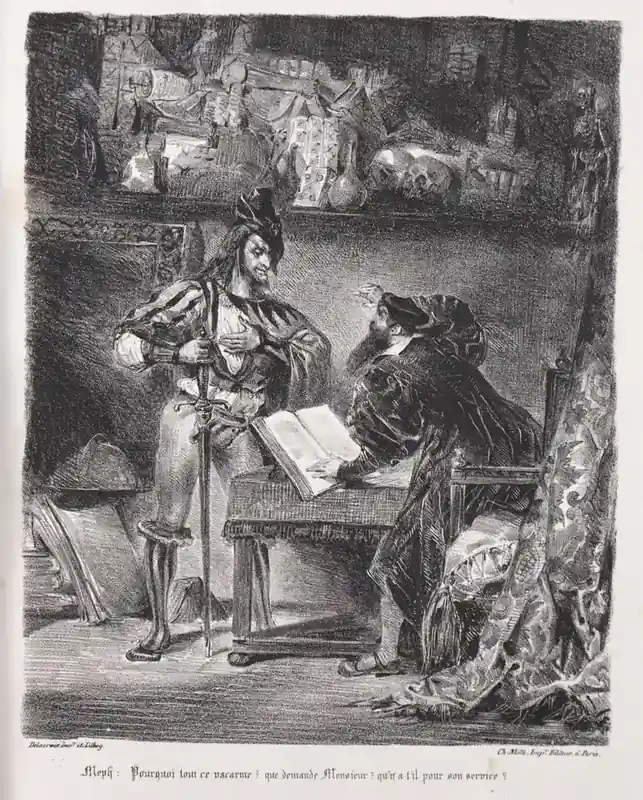
The wager hinges on a single grammatical move English cannot reproduce: Werd ich zum Augenblicke sagen is in the subjunctive II, the mood German reserves for hypothetical futures, polite requests, and counterfactuals. The whole sentence is balanced on the edge of unreality. Faust is not promising; he is naming the condition under which the promise would activate. English subjunctive collapsed into the indicative four centuries ago, so 'if I shall ever say' has to do the work of two grammatical states at once and inevitably loses the second.
Verweile doch — du bist so schön. Three words in German, eight in serviceable English. Verweile is an imperative that contains the request to linger and the acknowledgement that lingering is what the addressee does not naturally do. Doch carries the weight of pleading, recognition, and resignation in a particle no English word reproduces. Schön at line-end rhymes against gehn (perish) so that the very rhyme says: to call something beautiful enough to stop for is to call for one's own ending. A reader of the German hears the death in the rhyme. A reader of the English does not.
- vmPFCstrongest response
- dmPFCmoderate response
- PCCmoderate response
- Amygdala (L)moderate response
Literature-informed composite. Not a TRIBE measurement. Drawn from the neuroscience papers cited in the About page.
- Broca's region (L)moderate response
- Middle Temporal (L)moderate response
- Angular Gyrus (L)moderate response
- vmPFCminimal response
Literature-informed composite. Not a TRIBE measurement. Drawn from the neuroscience papers cited in the About page.